
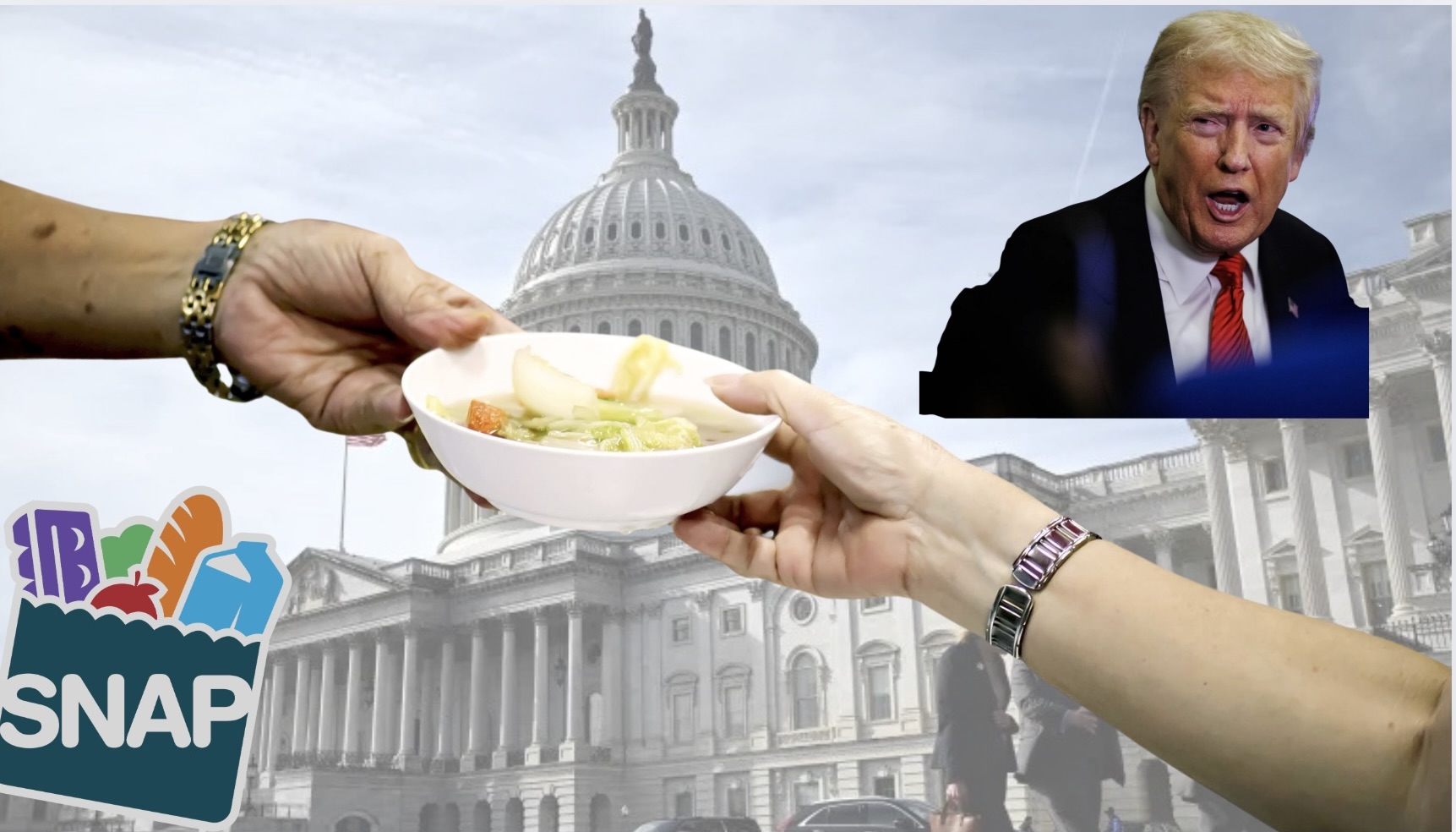
With the most recent government shutdown being the longest in American history, many jobs and livelihoods are on the line without federal funding. Most of all, the 42 million Americans who are helped by SNAP (Supplemental Nutrition Assistance Program) are in danger due to the benefits not being distributed until federal funding is continued. That leaves us, the American people, with a responsibility to combat food insecurity and keep these struggling families afloat.
The first Food Stamp Program was launched during the Great Depression in 1939, reaching 20 million Americans, however it was halted in 1943 due to better food conditions and employment during World War II. President Lyndon B. Johnson requested congress to make food stamps a permanent assistance program in 1964 during his “War on Poverty” mission to aid the vast lower-income communities. Through eras of food stamp expansion and destruction, the program officially became Supplemental Nutrition Assistance Program and has consistently helped families stay afloat during economic hardships, family crises, and periods of change.
In order to be eligible for SNAP, a family’s income must be in accordance with the guidelines for gross monthly income, net income, and assets. Generally, families on SNAP fall at or below the 130 percent of the poverty line.
Since Trump’s administration took over, SNAP has been on the road to adjust due to the “Big Beautiful Bill” that was passed in July 2025, with many people losing SNAP or having their benefits cut due to higher guidelines and more harsh eligibility criteria under the legislation.
However, on October 1, when Republicans and Democrats failed to agree on passing a funding bill, with 60 senate votes short the government shut down. With the longest government shut-down in history, many federal employees and agencies are unable to function or aid individuals. While October’s SNAP benefits were able to be distributed, November’s have yet to be given to families.
A federal judge, Jack McConnell, ordered this past week that the Trump administration must fund the SNAP benefits by November 7. This was because “The evidence shows that people will go hungry, food pantries will be overburdened, and needless suffering will occur,” if SNAP is not fully funded, said McConnell. Yet Trump quickly dismissed this emergency order, “until the Radical Left Democrats open up government,” going against his previous statement that the Executives would provide partial SNAP funding even amidst a Congressional gridlock.
The dismissal of this case brings light to the repercussions of the “Big Beautiful Bill” cutting welfare spending for many families as well as the lack of bipartisan communication in order to end the government shutdown. Additionally, it underscores the severity of Trump’s lack of cooperation to work with other parties and branches, pointing to his unfavorable tendency to ignore the constitutional pillars of checks and balances and separation of power.
Most recently, the Supreme Court just allowed Trump to pause SNAP benefits, also pointing to the tendency for the SCOTUS to approve Presidential decisions. Vice President JD Vance would even go on to say that it was “absolutely insane” for McConnell to order the Trump administration to financially assist the SNAP program, even though his memoir, “Hillbilly Elegy”, shows that food stamps were a critical program throughout his own upbringing.
The fact that SNAP benefits are on the line shows the extent to which this government shutdown is dehumanizing those who need these benefits on a day to day basis. Data shows that 86% of all SNAP recipients have a household member that is either a minor, elderly, or disabled. With 39% households specifically having children, 20% specifically caring for the elderly, and 10% supporting disabled individuals.
View this post on Instagram
Despite these statistics conveying that SNAP most profoundly supports marginalized communities throughout America, society has turned this program into a stigma, with hurtful stereotypes degrading those who use the benefits. Specifically, these stereotypes paint the narrative that those who are on SNAP are “lazy” and “cheating the system”.
Many times, families are criticized for buying their children snacks on food stamps that are not considered “the essentials” like vegetables and meat. Others have criticized those who have addictions for using food stamps, even though addictions have been confirmed to be diseases. In other instances, politicians have been emphasizing that this program is wasting money feeding immigrants, even though throughout its duration, illegal immigrants do not and have never qualified for food stamps. In reality, Food stamps have only ever been given to a handful of legalized immigrants who’ve been in the country for five years or those seeking asylum.
Granted, there is a critical need to squash these stereotypes and dig deeper into the true meaning of the Food Stamp Program and how it helps people in need. People most recently have been posting their SNAP stories on social media, including single mothers who have needed it in addition to working multiple jobs, those going through nursing school and working, and those recovering from job losses or debilitating accidents.
History Department Chair Lori Kearney said, “My husband was very thankful for government assistance because his family was able to stay afloat because of them. In the eighties he was a single father who got into a bad car accident, leaving him with no choice but to use them. Going back to work and being so thankful for food stamps, he was able to pay back the state of New York. Receiving a check back after overpaying them, he keeps the check to remind him that no one is that far away from disaster, and he was so grateful for their help. I think students often look at their teachers and don’t think about how many of them have experienced hunger, discomfort, and used many welfare programs.”
These stories point to the importance of eradicating SNAP’s stigmatization and recognizing that each family on SNAP has their own story, their own needs, and their own dignity. In President FDR’s “Four Freedoms” speech in 1941, he addresses the country’s need to protect all people’s “freedom from want”. This freedom states that America is responsible for helping their citizens with economic security, specifically giving the American people, “healthy, peaceful lives, free from hunger, poverty, and lack of basic necessities.” Through this weaponization of food stamps, this freedom from want is on the line and hungry citizens are being dehumanized due to their condition of needing government assistance to feed their families.
SNAP benefits are not a republican nor democrat issue, but one of basic human empathy, decency, and compassion. The weaponization and fluidity of sending out food stamps proves the delicate state of our country, pointing towards its polarization, finger pointing, and government-first mentality on the rise.
Food stamps have been credited with saving lives and building stability for families since its establishment in the 1960s, helping students graduate, single mothers keep afloat, and prevent those on SSI from choosing between their medicine or food groceries. As students at a Catholic school intertwining the core values of dedication to justice, service to the poor and marginalized, and a dedication to women and children, it’s important to recognize these injustices and advocate for those in need and who’ve been discriminated against.
Social Studies teacher Chris Hoffman said, “My dad lost his job when I was 14, leaving my mom with a 10th grade education scrambling to try to provide for us. I vividly remember our ‘welfare Christmas’ and living much differently than we had previously lived before. It was rough being a teenager going into high school and buying less expensive clothes and food than all the other kids. It made me appreciate the little things and conditioned me to budget.”
Although it’s impossible for Academy students to stop the government shutdown and get SNAP benefits rolled out, there are ways everyone can help. Most importantly, more people than ever should be donating to food pantries, with their numbers of families increasing exponentially. Specifically, Carrollwood’s Community Food Pantry has seen between a 25-50% increase since the shutdown occurred. Posting opportunities for free meals and resources for those needing food is also an important avenue for helping the cause. Lastly, simply standing up for those on food stamps and squashing the negative stereotypes placed on those who need them will stop the weaponization of the government program and show its fundamental importance in this nation.
View this post on Instagram
This government shutdown and the lack of checks and balances in store is leading to a hostile environment for millions of people. Putting SNAP benefits on the line is perhaps one of the most severe issues to so far come out of the shutdown, discrediting almost a century of political efforts to feed all people, even those in poverty. Access to food isn’t a privilege, but a freedom that’s been granted in America, and it’s up to the citizens with the ability to call out injustices and use their voices to fight for what’s just and get food in the hands of families in need.
Sophia Taveras (’27) said, “I believe food stamps are a necessity because one in five families are statistically on SNAP. I believe food is a right and should be accessible to everyone.”


Dina • Nov 11, 2025 at 12:47 pm
Great story! Keep using your voice to make a difference in the world. Despite one’s political beliefs..When we know better, we do better!