
If you’ve been reading AHN’s school email chain, students and faculty have most likely taken note of the surplus of emails from girls asking for participants in their research projects. This might come as a surprise to some since research projects have never been conducted within school walls, but for the 2025-2026 school year, it has consumed the minds of 30 curious AP Research students working towards contributing to scholarly conversations and society’s existing pool of published research.
AP Research, a course that has just completed its first year of AHN offering, is the second year course of the College Board AP Capstone program. The first year consists of an AP Seminar, a course that develops students’ critical thinking, synthesis skills, and collaborative project focus and is in its second year of AHN instruction.
If AP Seminar students opt into AP Research, they spend part of their summer brainstorming what they would want to study for their year-long project. Upon returning to school in August, juniors and seniors hit the ground running to delve deeper into their desired topics. After some time narrowing questions, curiosities, and interests, students begin planning what they want to study, how, and the why behind their topic.
Humanities Moderator Dr.Allison Alberts said, “When I pitched the Capstone program to the AHN faculty in 2022, I could have never imagined that this class would be as wonderful as it has been. I have loved shepherding my students through Seminar and Research and witnessed how they have become true subject-area experts in their fields. It’s been one of the top experiences of my teaching career.”
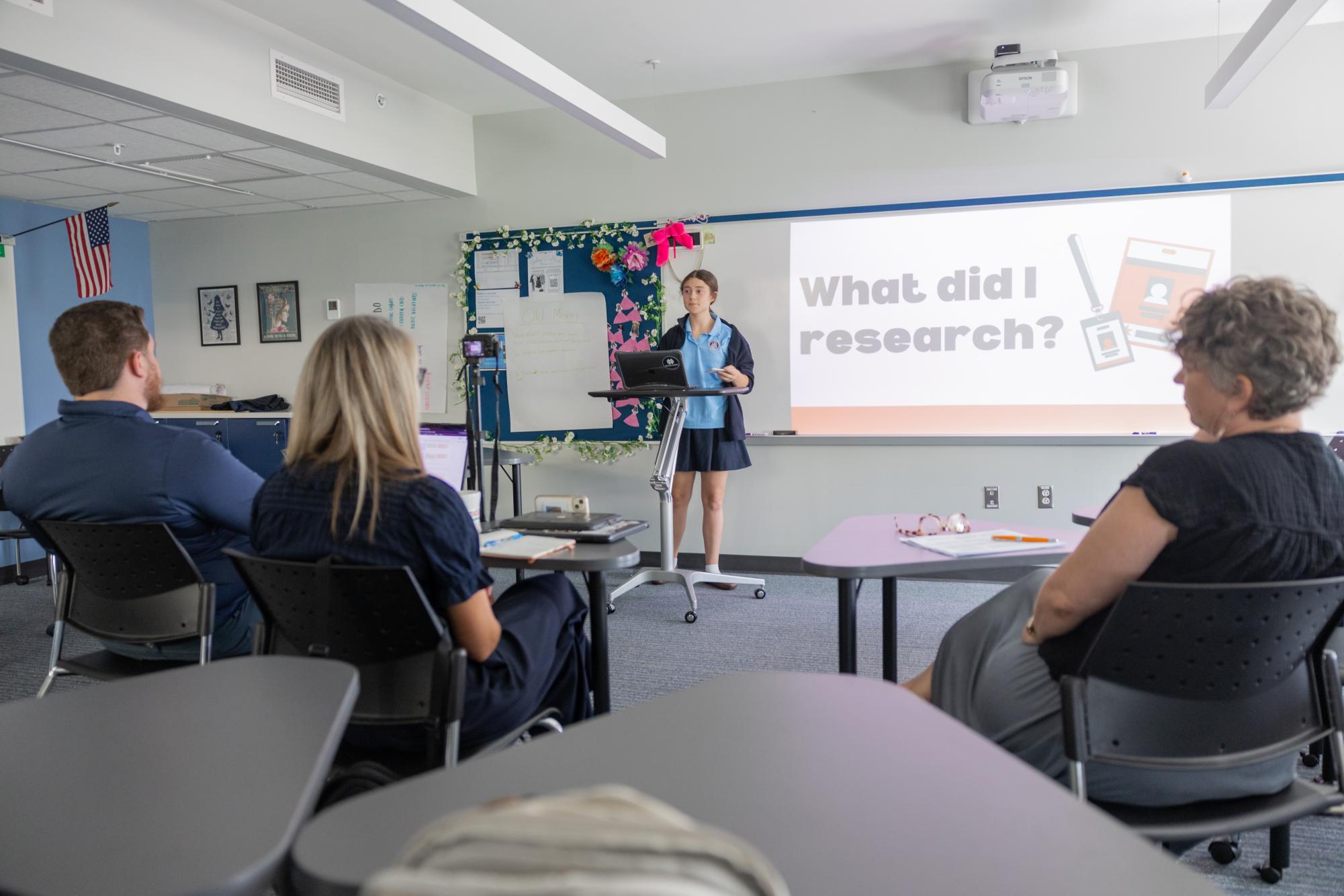
The year is broken into two major parts: writing their research paper and preparing for their POD (presentation and oral defense). However, the research paper preparation is broken down even further from September through March. In September, girls build their research database with annotating bibliographies. In October, students wrote their literature reviews which provide historical and social context, establishing their gap from the research pool. From Halloween to Christmas, students decide how to execute this research gap, deciding on data collection and methodology options. Returning for the Spring semester, students spend January and February collecting their data and conducting their experiments, this included surveys being sent out, interviews being held, cross temporal and phenomenological research being done, and more mixed methods being carried out.
For the last section in March, students recorded their data results and findings, and spent time analyzing the meaning behind these results to discover its broader meanings- finalizing their “new understanding” and conclusion for their research discipline. Right afterwards, students began carving out their multimedia projects, condensing this seven-month-journey into 10-12 slides and diligently studying their research projects to establish credibility for their three oral defense questions. After many rehearsals, peer reviews, and feedback sessions, students presented their projects from April 14 to April 23, then made final tweaks to their papers for submission on April 28.
What is especially unique about this program is that students get to entirely decide what they find interesting and are passionate about to conduct their research on. Projects extend beyond ordinary boundaries, combining history and film studies, art therapy and psychology, health sciences and creative writing. Some students even delved deep into their everyday pleasures, analytically coding Gossip Girl outfits and spice tolerance of Buffalo Wild Wings. This allowed students to have more motivation to study their projects, driving them to better understand the intricacies of academia and contribute meaningfully to extensive fields.
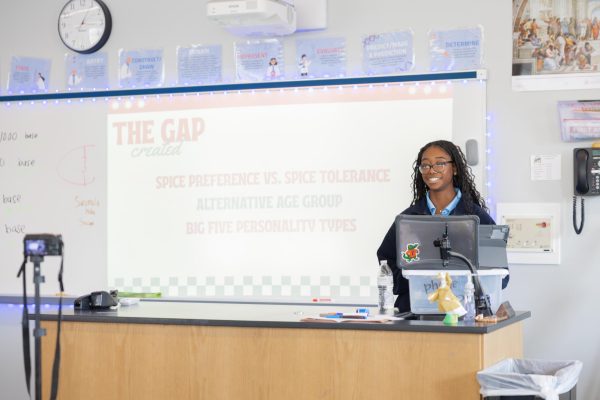
Junior Tia Smith said, “My research was about spice tolerance and what affects it, especially whether personality plays a role. I was interested in this because people react to spicy food so differently. My research question was: what extent do the Big Five personality traits predict an individual’s spice tolerance? I learned that spice tolerance is more complicated than I thought. I expected personality to have a strong impact, but my results showed little to no correlation. The only slight connection was with extraversion, but even that wasn’t very strong. This showed me that things like genetics and exposure probably matter more. I did a correlational study where participants took a personality test and then completed a spice test using wings with different heat levels. They rated the spice, and I used graphs to analyze the relationship. For my presentation, I focused on clearly explaining my process and results. I liked the experiment part the most—it was fun to actually run it and see people’s reactions. I want to take the research and analysis skills I learned and use them in future classes, especially in science-related fields.”
Junior Isabel Montoya decided to delve deep into the social sciences. She decided she wanted to study fracking and how the media presents this issue in a biased way. She hypothesized that when watching biased news, [viewers] opinions will not change. Next, she established her research gap: [how] this has been found in adults, [but] no one has looked at teenage girls, which she defines as “important to look at because they may be more vulnerable to framing because they don’t have fully formed opinions because they are still young.”
Montoya finally got to narrow down her research question: “Measured by a randomized pre- and post-questionnaire, to what extent does exposure to differently framed biased news segments about fracking relate to confirmation bias among teenage girls in a private school in Tampa, Florida?” Through her extensive experimentation and data tracking she found her new understanding: from before and after watching biased news clips about fracking, teenage girls’ opinions did not statistically change. She concluded that her project shows confirmation bias limited the effect of biased news just like adults. Most importantly, she found joy in teaching participants about fracking and watching debates around the issue unfold. She felt the importance of democracy working through this project and wants to keep working in the political science field!
Junior Katelyn Hoar had an interest in engineering, creating an experiment to test the performance of coffee grounds as insulation. After reviewing existing studies on the topic, she found her research question: through a true experimental study, what role does the coarseness of coffee grounds play in its thermal insulating efficiency? From creating a model and testing different insulations, she found that the coarseness does not significantly affect the insulation’s ability to insulate. She is really pleased with her results and wants to further investigate how other variables could be manipulated to maximize coffee insulation performance. Additionally, Junior Virginia Luka decided to explore film studies, honing in to research the role of gore in horror movies. After going through different perspectives and statistics, she narrowed down her research question: through a content analysis of five horror films released in 2025, what role does gore play in influencing the box office revenue and critical performance of horror movies? From her content analysis, she gathered that “gore has a positive correlation with box office revenue and reviews, so filmmakers may start to incorporate more gore into their films to make more money.” This has pushed her to look into studying Film, Television, and Media at select universities.
It is undeniable that these research projects positively impacted these 30 scholars’ high school experiences and educational development. This research project not only gave them a taste of academic freedom, intellectual curiosity, and legitimate college-level responsibility, but allowed them to explore their passions and discover important takeaways from their experiments that add depth to their academic portfolios.
STEM Moderator John Felletter said, “I have deeply enjoyed my experience as a moderator of AP Research. As we finish the year, I’m struck by how far each and every one of our students has come. What started off as a spark of passion or curiosity has bloomed into such a wide variety of projects and pursuits. I’m so impressed with the professionalism and expertise that each of our students has developed this year, and I don’t think there is any other class on campus that challenges and elevates our students in quite the same way as AP Research.”


