



After a successful 25 year career full of broken records and barriers, Misty Copeland retires as the first African-American principal ballerina at the American Ballet Theatre.
Copeland has shattered the glass ceiling as a trailblazer advocating for diversity in a predominantly white profession. Her work has inspired minorities all over, and allowed them to believe they too can achieve excellence in a space that has historically excluded them. The road to greatness was one full of twists and turns, Copeland persevered through an assortment of trials and tribulations that greatly influenced her life.
In an interview with the New York Times, Copeland described her upbringing as unstable. “I would go from day to day, night to night not knowing where we were sleeping, not knowing if we were going to have food, not knowing how I was going to get to school, if I was going to school.”
Her affinity for dance stemmed from her middle school drill team where her talent stood out, and she was recommended to take some classes. From there, Copeland engaged in ballet classes at the San Pedro Ballet School. The San Pedro Ballet School was the catalyst for so many opportunities of exposure for Copeland. In 1998, at 15, she won first place for ballet in the Los Angeles Music Center Spotlight Awards. Later, she received a full scholarship to attend the intensive summer program at the San Francisco Ballet.
In 2008, Copeland received another scholarship to participate in an intensive summer program with the American Ballet Theatre. In addition, she earned the National Coca-Cola Scholarship. From there she was invited to join the ABT company where she trained at an intense degree. Copeland was extremely dedicated to improving, she was classified as a late starter and had some catching up to do.
Junior Presley Frye had danced for seven years at New Level. Learning to dance on pointe was a challenging experience for her.
“At first it was very frustrating, a lot of people in my pointe class were ahead of me because they had prior experience. Once I started putting in the work, and taking it more seriously I got better at it.”
After some time in the junior company, Copeland continued to climb the ranks on the main stage. In 2007, she was promoted to soloist where she kept refining her craft and performing at an exceptional level. In 2015, Copeland was promoted to principal dancer at ABT.
At times, it would be difficult to exist in a space where she was the only African American ballerina. On top of that, Copeland wasn’t built like her peers. Oftentimes she was told that “she was more muscular and full-figured than her peers,” but she didn’t let this comparison stop her.
Since 1939, Copeland is and remains the only black prima ballerina at American Ballet Theatre. Her leaving the company means there will no longer be an African-American principal dancer. Having a diverse visual representation of performers prompts observers to believe that they too can have a space in the ballet community.
Senior, Emma Diaz, has been dancing ballet for 15 years at New Tampa Dance Theatre. Copeland inspired Diaz to keep dancing in eighth grade when it felt overwhelming balancing school and ballet, being an example for perseverance and passion.
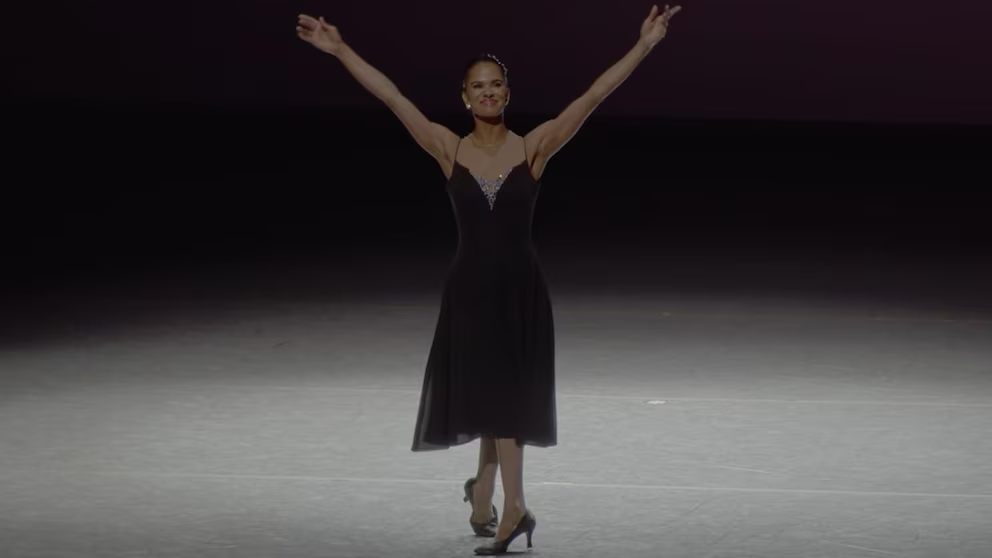
The closing of Copeland’s career was honored at the American Ballet Theatre’s Fall Gala. Notable figures, such as Oprah Winfrey and Debbie Allen, came to celebrate Copeland’s retirement and acknowledge the hills she has climbed.
In her speech, Winfrey said that Copeland did more than just perform ballet, “[S]he changed it. She redefined who belongs, who gets to be seen, and who gets to lead.”


